

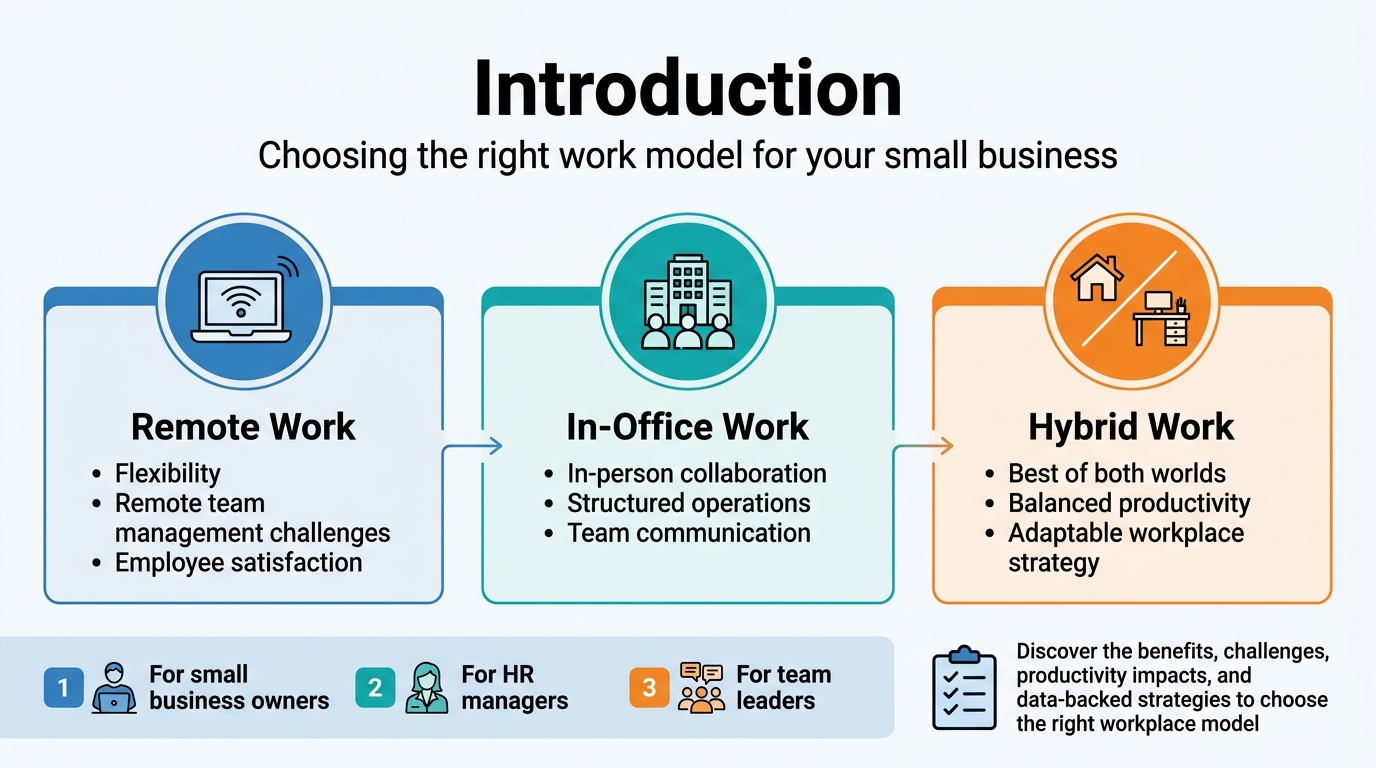
Small business owners face a critical choice that impacts everything from employee satisfaction to the bottom line. Should your team work remotely, stay in the office, or find a middle ground? This debate has moved beyond temporary pandemic measures to become a permanent strategic decision.
This guide is for small business owners, HR managers, and team leaders who need to choose the right work model for their company. We’ll examine the real benefits and challenges of remote work vs office work, analyze how different work arrangements affect employee productivity and business operations, and explore hybrid solutions that might give you the best of both worlds.
You’ll discover practical insights about remote team management challenges, in-office collaboration advantages, and data-backed strategies to help you make the right choice for your small business workplace strategy.
Understanding the Core Differences Between Remote and In-Office Work
Flexibility vs Structure in Daily Operations
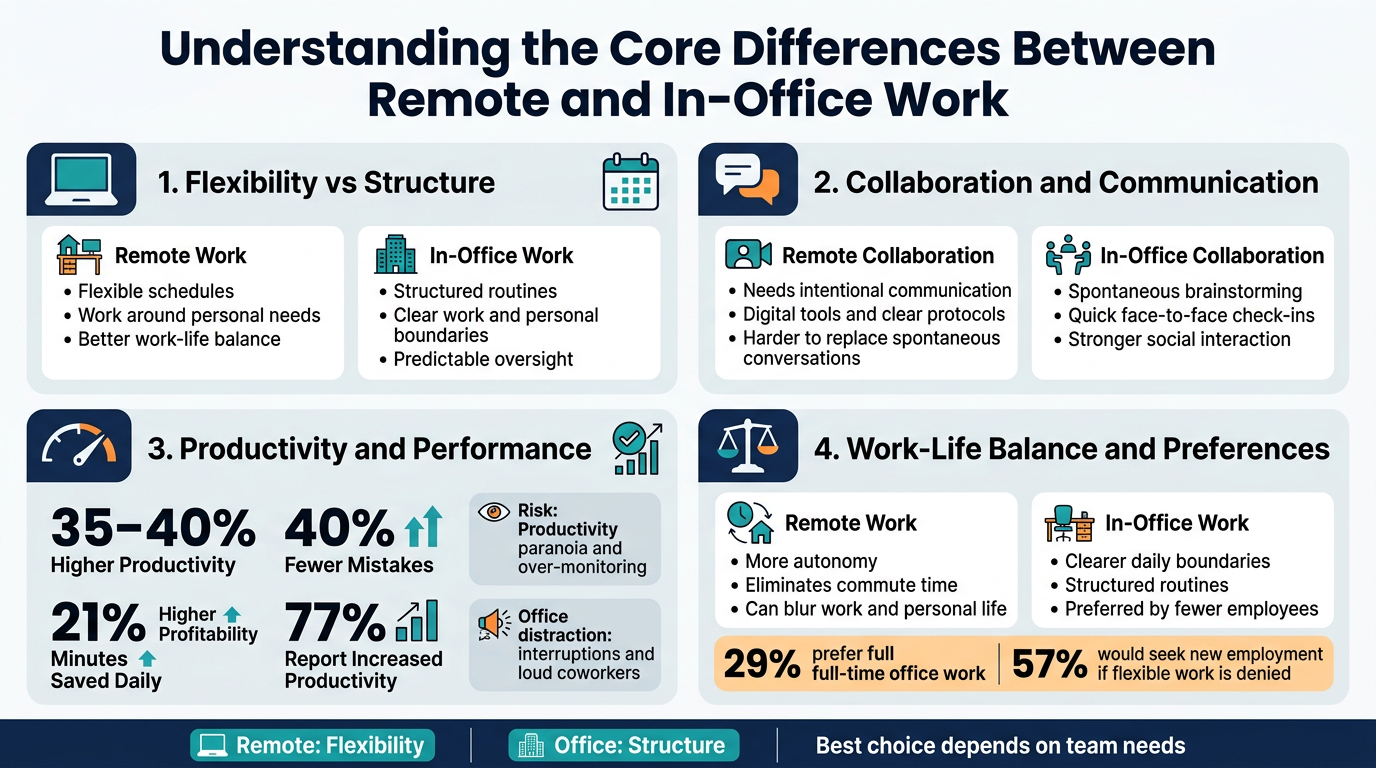
Remote work vs office work models present fundamentally different approaches to daily business operations for small businesses. Remote work offers unparalleled flexibility, allowing employees to design their workdays around personal needs and peak energy levels. Workers can manage school pickups, handle personal appointments, and work during their most productive hours – whether that’s early morning or late evening. This flexibility improves work-life balance for employees and can lead to higher job satisfaction.
In contrast, office-based operations provide structured routines that many small businesses find beneficial. The physical workspace creates clear mental transitions between “work mode” and personal time through rituals like morning commutes and team stand-ups. For small business owners who need predictable schedules and immediate oversight, the structured environment of an office can ensure consistent operational standards and accountability.
Collaboration Styles and Communication Patterns
The choice between remote team management and in-office work significantly impacts how small business teams collaborate and communicate. In-person collaboration offers distinct advantages through spontaneous conversations, impromptu brainstorming sessions, and quick face-to-face check-ins. Research shows that face-to-face interactions heighten brain activity and create richer social interactions, which can be crucial for small businesses that rely on creative problem-solving and rapid decision-making.
Remote work collaboration, while different, has proven effective with proper technology implementation. However, it requires more intentional communication strategies. Small businesses must invest in digital tools and establish clear communication protocols to maintain team cohesion. The challenge lies in replicating those valuable “water cooler” conversations that build trust and foster innovation in traditional office settings.
Productivity Metrics and Performance Outcomes
Employee productivity remote vs office data reveals surprising insights for small business workplace strategy. Remote workers demonstrate 35-40% higher productivity compared to traditional office employees, with remote work including 40% fewer mistakes. Work-from-home employees save an average of 72 minutes daily by eliminating commutes, returning 40% of that saved time to their employers.
Companies implementing flexible work arrangements small business models show 21% higher profitability than fully in-person operations. Additionally, 77% of employees working remotely at least occasionally report increased productivity, with 30% completing more work in less time and 24% achieving more output within standard hours.
However, small businesses must consider productivity challenges on both sides. Remote work can lead to productivity paranoia among managers, resulting in over-monitoring that ultimately hurts performance. Conversely, office environments often present distractions like loud coworkers and constant interruptions that impede focused work.
Work-Life Balance Considerations for Small Teams
Small business work models significantly impact employee work-life balance, though preferences vary by individual. Remote work provides greater autonomy and control over daily schedules, allowing employees to better integrate personal responsibilities with professional duties. The elimination of commute time and the ability to work in comfortable, personalized environments contribute to improved work-life integration.
However, remote work challenges solutions must address the blurred boundaries between work and personal life. When the kitchen becomes the office, many employees struggle to “log off” mentally, leading to potential burnout. Some workers find it difficult to maintain separation between professional and personal spaces, which can negatively impact long-term mental health.
In-office work offers clearer boundaries and structured routines that help employees transition between work and personal time. Yet only 29% of surveyed employees prefer full-time office work, with the majority favoring remote or hybrid arrangements. Small businesses must carefully consider these preferences, as 57% of employees would seek new employment if denied flexible work options.
Remote Work Benefits That Drive Small Business Success
Eliminating Commute Costs and Time Waste
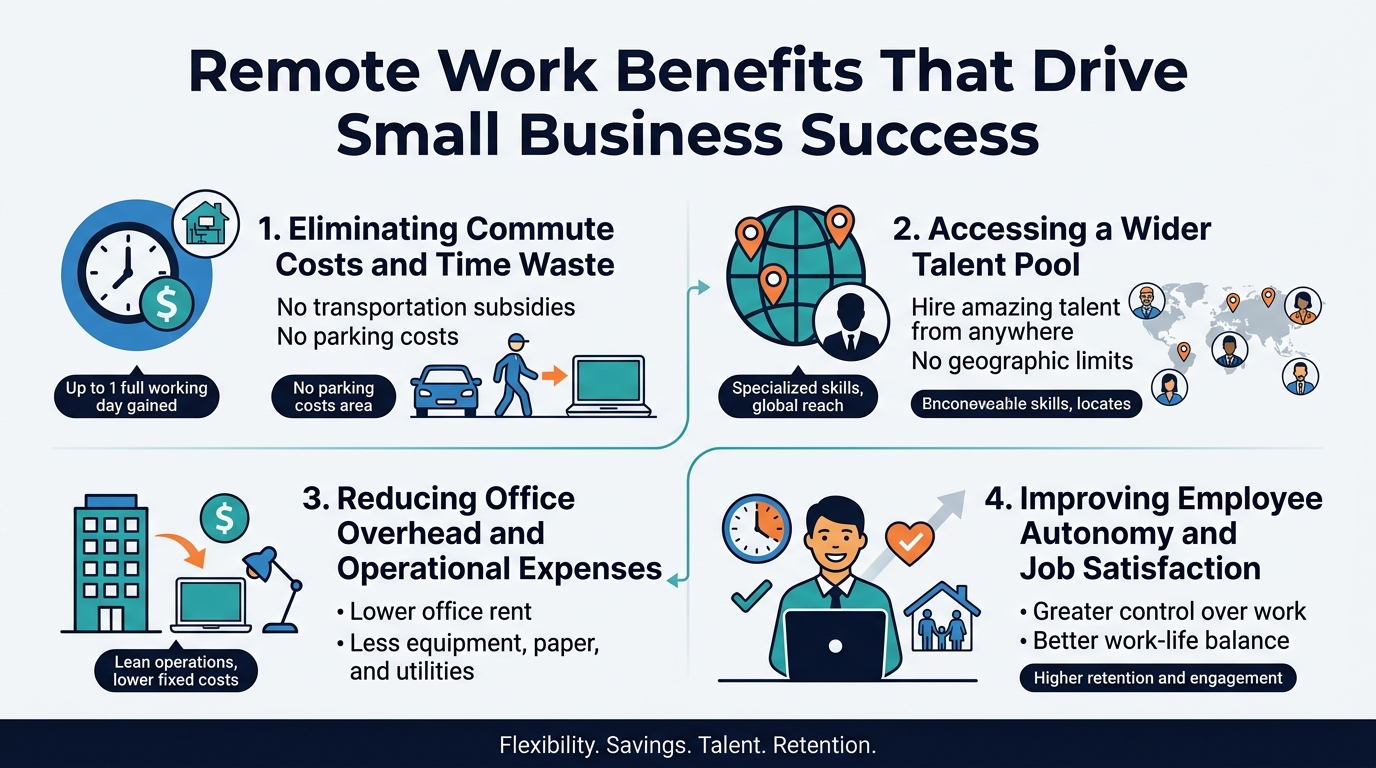
Remote work delivers immediate financial relief for small businesses by eliminating commute-related expenses and time inefficiencies. When employees work from home, businesses no longer need to subsidize transportation costs or provide parking facilities, creating direct savings that impact the bottom line. The Stanford University study referenced in productivity research demonstrated that remote workers gained the equivalent of one full working day in productivity, largely attributed to the elimination of commuting time that can now be redirected toward productive work activities.
This time recapture extends beyond individual productivity gains. Small businesses operating with lean teams particularly benefit when employees can start work immediately rather than losing 1-2 hours daily to commuting. The cumulative effect across a small team can translate to significant operational advantages, allowing businesses to accomplish more with existing resources while reducing overhead costs associated with commuter benefits.
Accessing Wider Talent Pool Beyond Geographic Limits
The removal of geographic barriers represents one of remote work’s most transformative advantages for small business growth. As highlighted in the research, companies can now “hire amazing talent from anywhere without being limited by office locations,” fundamentally changing recruitment strategies for small businesses that previously competed only within limited local markets.
This expanded talent access proves especially valuable for small businesses seeking specialized skills. Rather than settling for locally available candidates or competing with larger corporations for talent willing to relocate, small businesses can now recruit internationally. The ability to hire native speakers for global markets or specialists in niche areas without relocation requirements levels the playing field against larger competitors who traditionally held geographic advantages.
Small businesses can now compete with industry giants by offering remote opportunities to top-tier professionals who prioritize flexibility over physical location, creating access to expertise that was previously financially or logistically impossible to obtain.
Reducing Office Overhead and Operational Expenses
Remote work enables substantial reductions in office rental costs, which represent one of the largest fixed expenses for small businesses. The research indicates that companies can significantly reduce required office space or potentially eliminate centralized workplaces entirely, instead utilizing meeting rooms or co-working spaces only when needed.
Equipment costs decrease dramatically when employees use personal computers and smartphones, eliminating the need for businesses to purchase and maintain extensive hardware inventories. The reduction in paper consumption, printing supplies, and office utilities creates additional savings that accumulate over time. For small businesses operating on tight margins, these cost reductions can mean the difference between profitability and financial strain.
Facebook’s executive remote work initiative demonstrates how even large corporations recognize the financial benefits, with potential savings reaching millions of dollars through reduced office footprints and locality-based pay adjustments.
Improving Employee Autonomy and Job Satisfaction
Remote work significantly enhances employee autonomy, creating a workforce that feels valued and respected. Research shows that providing remote work opportunities leads to improved employee engagement and higher performance metrics, as workers gain greater control and ownership over their work environment and schedule.
This autonomy translates directly into reduced employee turnover, which proves especially valuable for small businesses where replacing trained staff is costly and disruptive. The flexibility allows employees to maintain better work-life balance, accommodating personal responsibilities like childcare that might otherwise force valuable team members to leave the company.
The enhanced job satisfaction from remote work flexibility helps small businesses retain talent that might otherwise be attracted to larger corporations offering similar benefits, creating a competitive advantage in talent retention while building a more loyal and engaged workforce.
Remote Work Challenges That Impact Small Business Operations
Managing Isolation and Team Disconnection
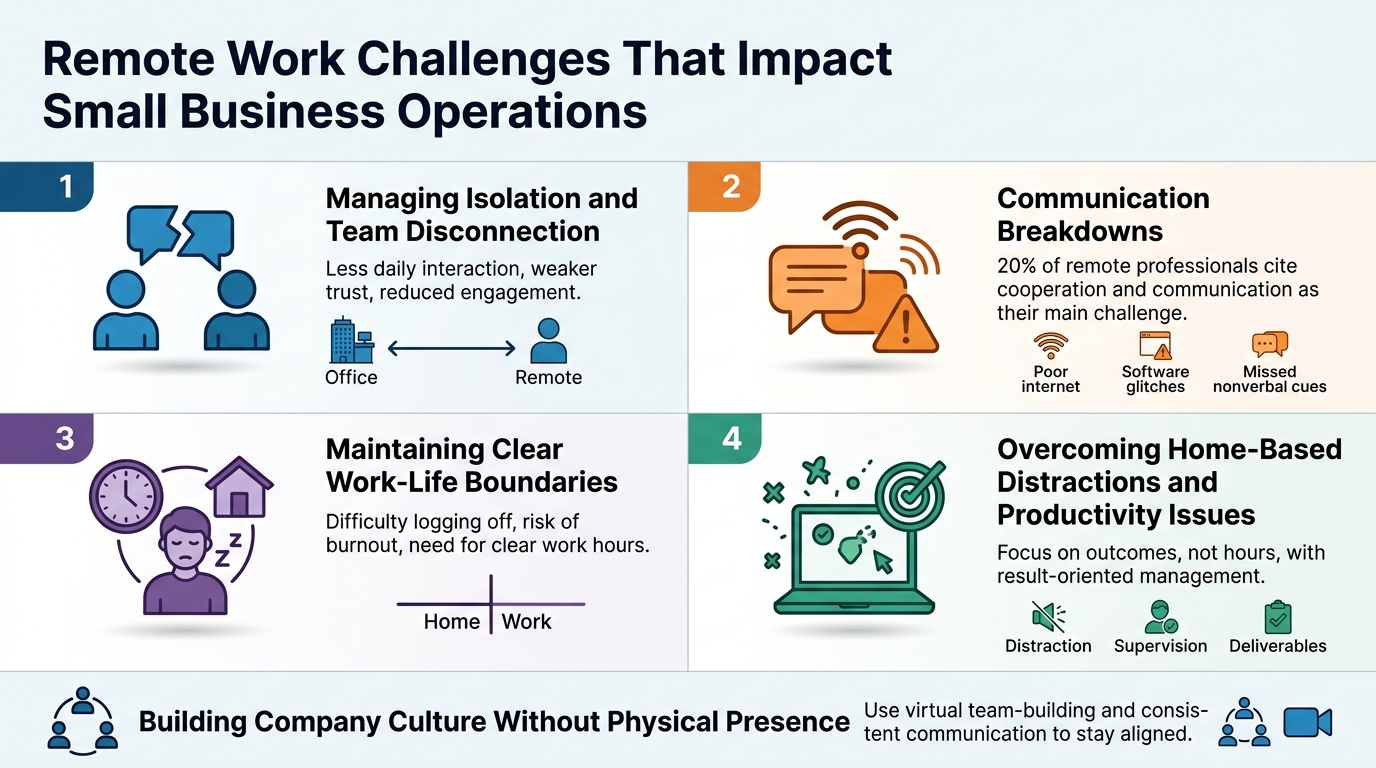
Remote work challenges for small businesses often begin with team members feeling disconnected from their colleagues and the company mission. Without everyday office interactions that foster a shared sense of purpose, small business teams may struggle to build trust and rapport that comes naturally in physical environments. This disconnection becomes particularly problematic for small businesses where each team member’s engagement directly impacts overall productivity and company culture.
Communication breakdowns represent a significant risk, with approximately 20% of remote professionals identifying cooperation and communication as their primary challenge. Small business teams operating remotely may experience collaboration delays due to poor internet connections, software glitches, or the diminished ability to interpret nonverbal cues that convey meaning in face-to-face interactions. These delays can create ripple effects that contribute to overall efficiency losses, which small businesses can ill afford.
Maintaining Clear Work-Life Boundaries
Remote team management becomes complex when employees struggle with boundary-setting between their professional and personal lives. Many remote workers report difficulty logging off and recharging, leading to potential burnout issues that can severely impact small business operations. Without clear work hours and expectations, remote employees may either overwork themselves or struggle to maintain accountability.
Small business owners must recognize that while remote workers often enjoy enhanced well-being compared to their on-site counterparts, they simultaneously face unique challenges with isolation and disconnection. Effective remote work strategies require clear policies defining work hours and encouraging employees to disconnect when needed.
Overcoming Home-Based Distractions and Productivity Issues
Home-based distractions present ongoing productivity challenges that can significantly impact small business efficiency. While remote work offers autonomy, it also introduces various distractions, feelings of isolation, and potential lack of supervision that can negatively affect performance. Small businesses may find it particularly challenging to establish systems or metrics to effectively monitor and improve employee performance without the traditional oversight mechanisms available in office settings.
The key to addressing these productivity issues lies in implementing outcome-oriented management approaches rather than focusing on how remote employees spend their time. Small businesses benefit from prioritizing results while allowing employees to meet deliverables in ways that utilize their unique skills and knowledge.
Building Company Culture Without Physical Presence
Creating and maintaining company culture without physical presence represents one of the most significant remote work challenges for small businesses. Cultural integration becomes difficult when teams lack meaningful face-to-face interactions and shared experiences that typically occur in office environments. Small businesses, which often rely heavily on close-knit team dynamics, may struggle to replicate the cultural alignment that comes naturally through physical proximity.
However, cultural alignment can still be pursued digitally through virtual team-building experiences and consistent communication practices. Small business leaders must adapt their approach to foster connection and ensure team members feel they are working toward shared goals, even when distributed across different locations.
In-Office Work Advantages for Small Business Growth
Facilitating Spontaneous Collaboration and Innovation
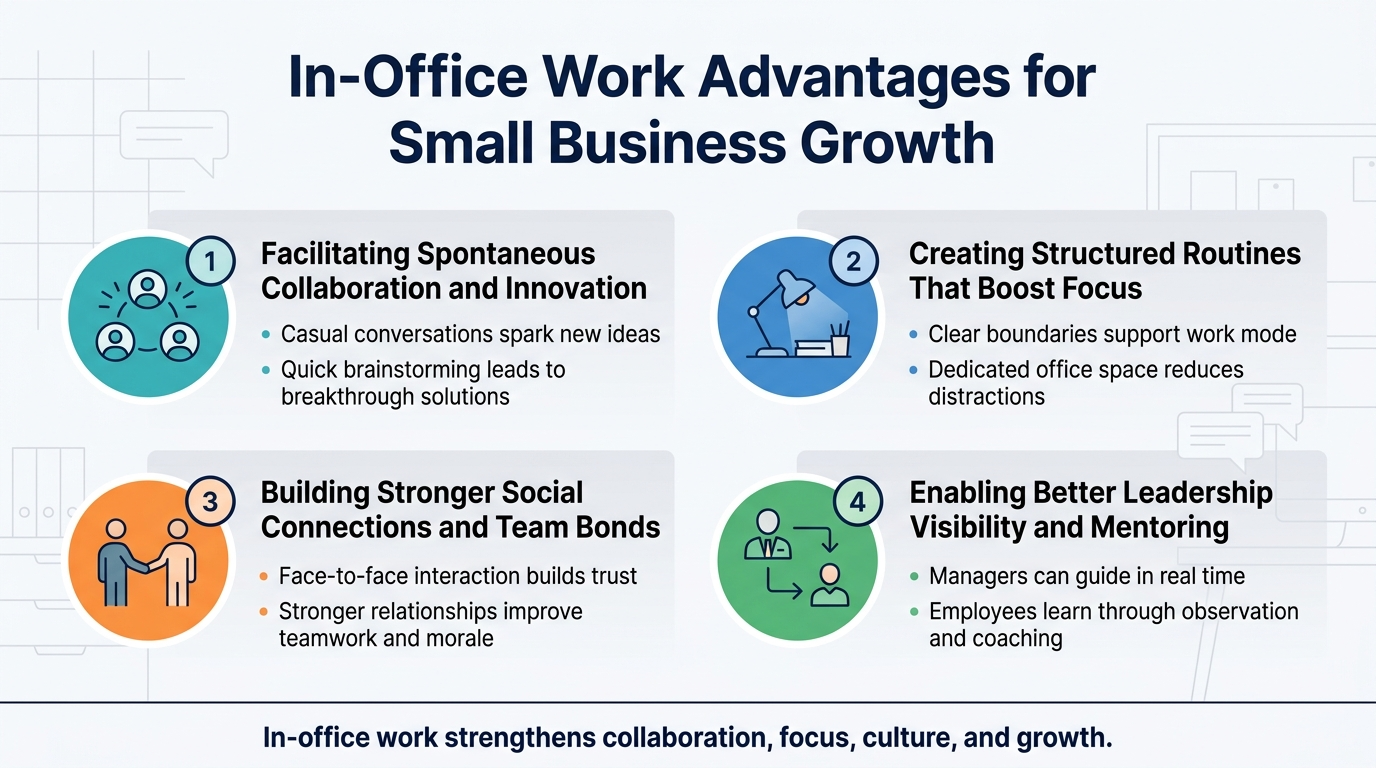
In-office work environments excel at creating opportunities for spontaneous collaboration that can drive innovation in small businesses. When teams share physical space, casual conversations at the coffee machine, impromptu brainstorming sessions, and quick desk-side consultations become natural catalysts for creative problem-solving. These unplanned interactions often lead to breakthrough ideas that might never emerge in scheduled video calls or structured remote meetings.
The physical proximity inherent in office environments allows team members to easily bounce ideas off one another, leading to more dynamic and innovative solutions. Small businesses particularly benefit from this collaborative energy, as their agile nature allows them to quickly implement new ideas generated through these spontaneous exchanges.
Creating Structured Routines That Boost Focus
Office environments provide natural structure that many employees find conducive to maintaining focus and productivity. The physical separation between home and work helps establish clear boundaries, allowing team members to mentally transition into “work mode” more effectively. This structured environment is particularly valuable for small businesses where consistent productivity directly impacts bottom-line results.
The office setting eliminates many of the domestic distractions that can impact work-from-home productivity, creating dedicated spaces for deep-focus work. Small business teams often report higher levels of concentration when working in purposefully designed office environments, leading to improved task completion and overall efficiency.
Building Stronger Social Connections and Team Bonds
Face-to-face interaction in office settings strengthens social connections and builds stronger team bonds that are crucial for small business success. Daily in-person interactions foster trust, improve communication, and create a sense of camaraderie that can be challenging to replicate in remote environments. These stronger relationships translate into better collaboration, increased employee loyalty, and improved team morale.
For small businesses, where team dynamics significantly impact company culture and performance, the relationship-building advantages of in-office work can be particularly valuable. Employees working side-by-side develop deeper understanding of each other’s work styles, strengths, and challenges, leading to more effective teamwork and mutual support.
Enabling Better Leadership Visibility and Mentoring
In-office work provides enhanced opportunities for leadership visibility and mentoring relationships that are essential for small business growth. Managers can more easily observe team dynamics, identify individual strengths and development needs, and provide immediate guidance when challenges arise. This direct oversight allows for real-time coaching and support that can accelerate employee development.
The mentoring advantages of office environments are particularly significant for small businesses, where knowledge transfer and skill development often happen through informal interactions and observation. Junior team members benefit from watching experienced colleagues in action, learning not just technical skills but also professional behaviors and decision-making processes that contribute to business success.
In-Office Work Drawbacks for Small Business Efficiency
Higher Real Estate and Facility Costs
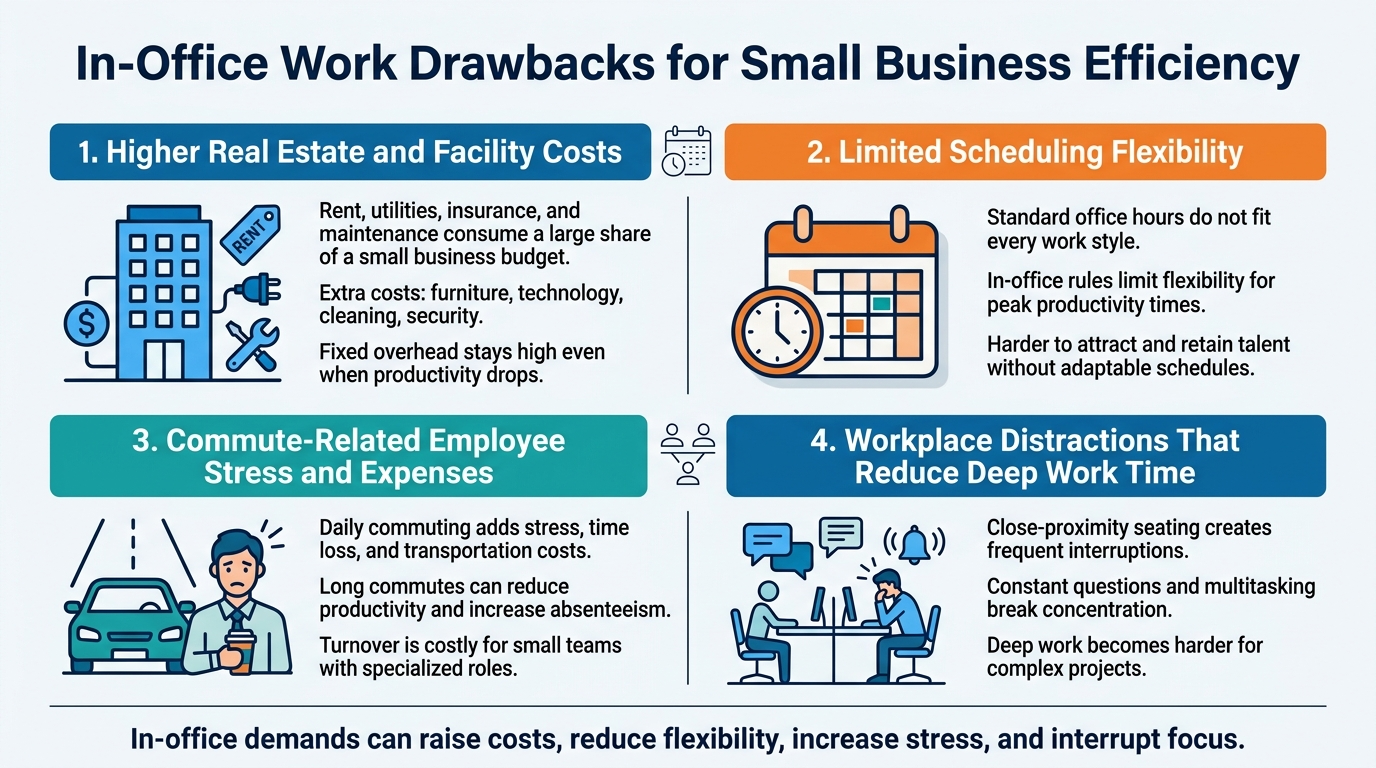
Small businesses face significant financial pressure when maintaining physical office spaces. Unlike large corporations with substantial budgets, smaller firms lack the financial resources to absorb high overhead costs effectively. Real estate expenses, including rent, utilities, insurance, and maintenance, can consume a disproportionate percentage of a small business’s operating budget. These fixed costs persist regardless of productivity levels or business performance, creating ongoing financial strain.
The burden intensifies when considering additional facility-related expenses such as office furniture, technology infrastructure, cleaning services, and security systems. Small business owners often find themselves personally invested in every expense, as one professional noted: “the owner/founder treated every expense as taking from his pocket.” This financial pressure can lead to compromising on office quality, with some small businesses struggling to maintain basic amenities like adequate supplies or proper facility upkeep.
Limited Scheduling Flexibility for Diverse Work Styles
Traditional office environments impose rigid scheduling constraints that may not align with optimal productivity patterns for all employees. Small businesses operating in-office models often struggle to accommodate diverse work styles and personal circumstances that could enhance employee satisfaction and retention.
The inability to offer flexible scheduling arrangements puts small businesses at a competitive disadvantage when attracting and retaining talented staff. Unlike remote work environments that naturally accommodate different peak productivity hours, in-office requirements force all employees into standardized schedules regardless of their individual effectiveness patterns. This inflexibility can be particularly challenging for small businesses that need to retain every skilled team member but cannot offer the scheduling adaptability that modern professionals increasingly expect.
Commute-Related Employee Stress and Expenses
Daily commuting creates both financial and psychological burdens for employees that ultimately impact small business operations. Commute-related stress affects employee wellbeing and can translate into reduced productivity, higher absenteeism, and increased turnover rates.
For small businesses, employee turnover is particularly costly as each team member typically handles multiple responsibilities and specialized knowledge. The stress associated with daily commuting, traffic delays, and transportation costs can contribute to employee dissatisfaction, making it more difficult for small businesses to maintain stable teams. Additionally, commute expenses effectively reduce employees’ take-home compensation, making small business positions less attractive when competing against remote work opportunities or companies offering flexible arrangements.
Workplace Distractions That Reduce Deep Work Time
Open office environments and close-proximity seating arrangements in small business settings can create significant interruptions that hinder focused work. The reference content highlights how employees in smaller organizations often experience constant multitasking demands and frequent consultations with colleagues, which can fragment attention and reduce deep work capabilities.
In small teams where “everyone is closer with each other,” the ease of interaction that benefits collaboration can simultaneously become a source of continuous interruption. Employees may find it difficult to engage in concentrated, uninterrupted work sessions when colleagues can easily approach with questions or requests. This constant accessibility, while fostering communication, can significantly impact productivity for tasks requiring sustained focus and analytical thinking.
The challenge is amplified in small businesses where employees wear multiple hats and handle diverse responsibilities, making uninterrupted time essential for managing complex projects effectively.
Hybrid Work Models That Maximize Small Business Benefits
Balancing Focus Days with Collaboration Sessions
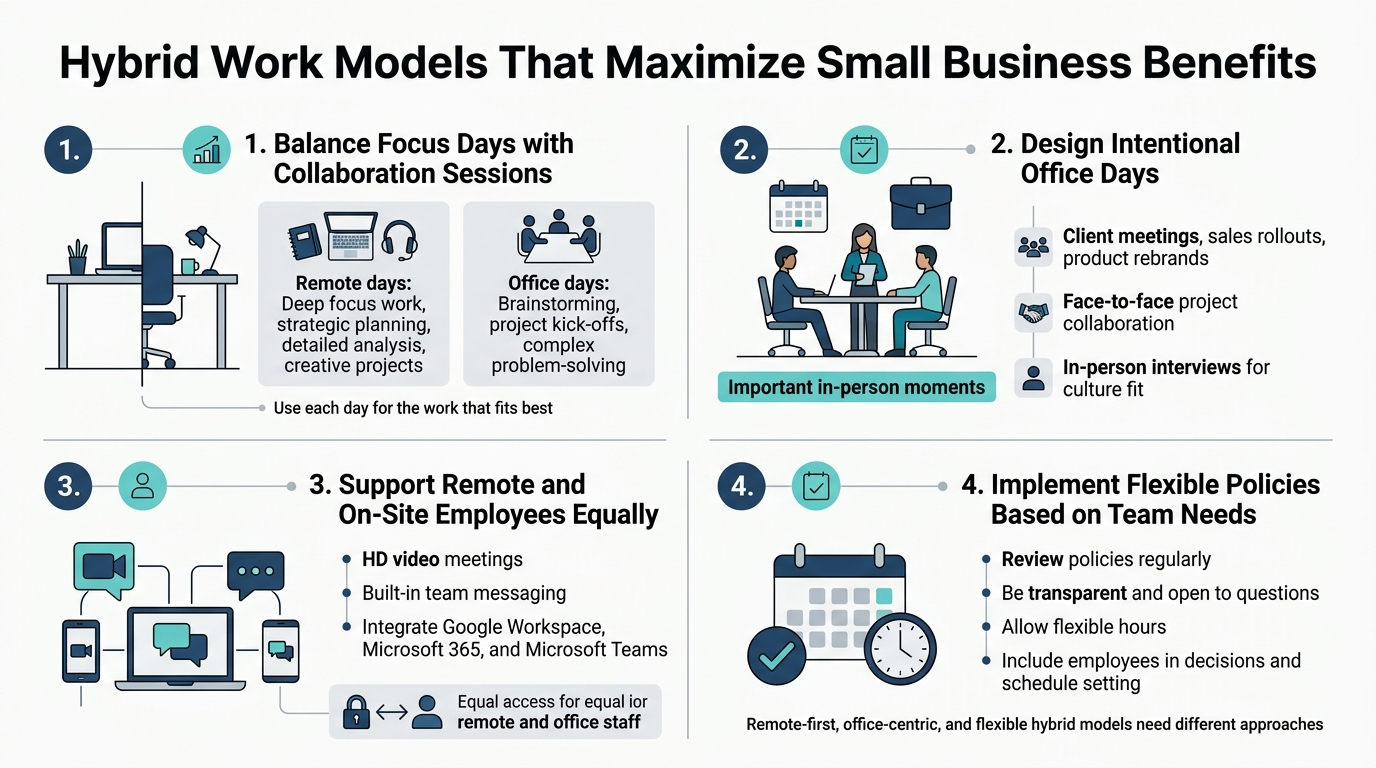
Organizations implementing hybrid work for small businesses can maximize productivity by strategically alternating between focused individual work and collaborative team sessions. This approach recognizes that some tasks require uninterrupted concentration while others benefit from face-to-face interaction. Staff working on work-from-home days in an office-centric hybrid model can treat their out-of-office days as time to focus more on personal projects rather than collaboration with others.
The key is establishing clear expectations around when certain types of work should occur. Deep focus work, such as strategic planning, detailed analysis, or creative projects, is often better suited for remote days when employees can minimize distractions. Conversely, brainstorming sessions, project kick-offs, and complex problem-solving activities benefit from the energy and spontaneous interaction that comes with in-person collaboration.
Designing Intentional Office Days for Strategic Activities
With this approach in mind, small businesses should thoughtfully plan which activities require physical presence in the office. Whether some meetings are better in person or by video depends on the specific objectives and outcomes desired. Some meetings are simply better held physically in meeting rooms, particularly client meetings, big sales initiative rollouts, product rebrands, or other important events where hosting an in-person meeting powerfully illustrates the meeting’s importance.
Projects requiring face-to-face collaboration also merit special consideration for office days. While video meetings make it possible to screen share and add notes “in the moment,” making these meetups as near to a physical meeting as possible, there are occasions when working together in a physical space is preferable to create connections between team members.
Additionally, conducting interviews often benefits from in-person interaction. While remote screening tools are regularly used as part of the recruitment process and provide a useful way to interview multiple candidates while saving time, face-to-face interviews can give deeper understanding of a candidate’s personality and how they might fit within the business culture.
Creating Equal Support for Remote and On-Site Employees
Now that we’ve covered strategic activity planning, ensuring equitable support for all team members becomes crucial for hybrid work success. It’s important to ensure that remote workers are not “siloed” and don’t miss out on important decisions or find it difficult to access advice and help. Small businesses must invest in robust technology solutions that create seamless collaboration experiences regardless of location.
Investment in remote technology plays an important part in whether hybrid work models work successfully, especially regarding collaboration. Teams need access to HD video meetings that make everyone feel like they’re in the same conference rooms, whether they’re in the office or working remotely. The ability to keep conversations going after meetings with built-in team messaging ensures continuity and prevents remote workers from feeling excluded from ongoing discussions.
Successful hybrid models also require connecting favorite apps such as Google Workspace and Microsoft 365 or Microsoft Teams, allowing employees to start meetings seamlessly from their preferred platforms. This integration prevents technology barriers from creating inequity between remote and on-site workers.
Implementing Flexible Policies Based on Team Needs
Teams implementing flexible work arrangements for small business success must develop policies that reflect their specific operational requirements and employee preferences. When developing hybrid work strategy, businesses should regularly review their hybrid working policies and maintain transparency across the board, giving everyone the opportunity to ask questions.
For office-first environments, it’s important not to be too rigid about hours worked, as some people work better early in the morning while others perform better later in the day. Offering workers the flexibility to set their own hours could help mitigate frustration they may experience with strict on-site mandates. Allowing staff involvement in decision-making processes and schedule setting can help prevent burnout and create better work-life balance.
Different hybrid work models require different approaches. In remote-first models where teams may only be in the office one to two days per week, employees need to think “hybrid collaboration first,” both in and out of the office. This differs significantly from office-centric models where remote days serve different purposes.
Regular policy reviews ensure that flexible work arrangements continue meeting both business objectives and employee needs as circumstances evolve.
Data-Driven Decision Making for Work Model Selection
Measuring Productivity Across Different Work Environments
When choosing between remote work vs office work for your small business, productivity measurement becomes critical for informed decision-making. Advanced workplace analytics provide comprehensive insights that go beyond traditional metrics like hours worked or tasks completed.
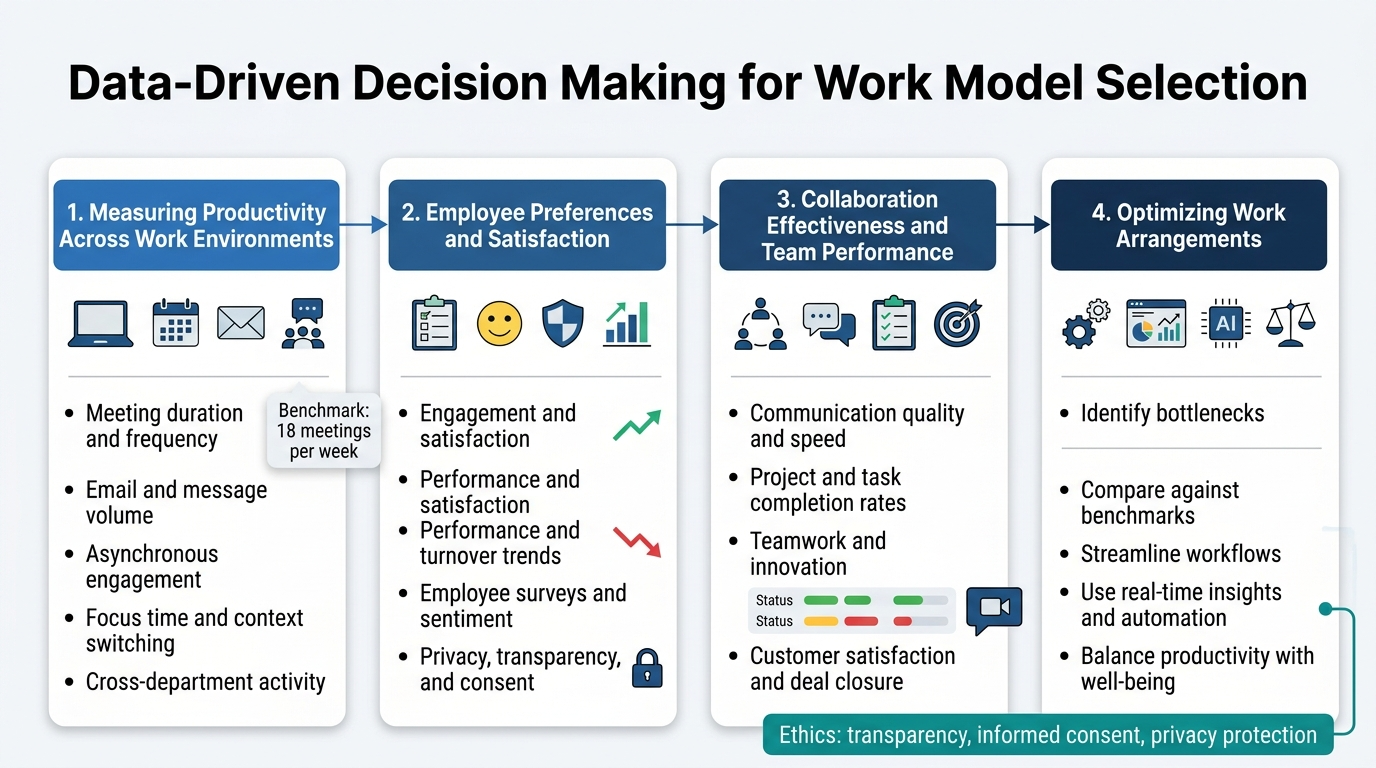
Effective productivity measurement in different work environments requires tracking collaboration indicators such as email frequency, meeting durations, and digital communication patterns. Companies like Microsoft employ Viva Insights to monitor average meeting durations, out-of-hours emails, and signals of work overload to realign their hybrid work policies. Similarly, Google combines Workspace analytics with employee sentiment data to measure well-being and responsiveness during collaboration.
Key collaboration metrics include the number, duration, and recurrence of meetings, volume and timing of emails and messages, asynchronous engagement levels, cross-department activity, network density, focus time, and instances of context switching. Industry benchmarks, such as Microsoft’s average of 18 meetings per week, help interpret organizational data effectively.
Small businesses can leverage collaboration data from tools like Microsoft Teams, Slack, Zoom, Google Workspace, Jira, and Trello to assess productivity across remote team management and in-office environments. This data-driven approach enables businesses to identify workflow bottlenecks and implement targeted solutions for improved performance.
Analyzing Employee Preferences and Satisfaction Levels
Now that we’ve covered productivity measurement, analyzing employee preferences becomes essential for determining the most effective work model for your small business. Employee engagement and satisfaction data measure how emotionally invested and satisfied employees are with their roles, workplace environment, and company culture.
High engagement and satisfaction typically correlate with increased productivity, decreased employee turnover rates, and improved morale. Conversely, low engagement can lead to poor performance and increased absenteeism. Companies like Google combine analytics with employee sentiment data to measure well-being during collaboration, while Salesforce uses well-being surveys alongside collaboration metrics.
Effective analysis involves gathering information from various sources, including employee surveys, performance records, and external benchmarks. This data is then examined to identify patterns, trends, and correlations that inform work model decisions. Visualization tools translate complex data into understandable formats like charts and graphs, making it easier to interpret employee preferences.
When implementing preference analysis, businesses must handle employee privacy concerns carefully. Employees need assurance that their personal data is safe and only used to improve productivity. Being transparent about data collection methods and the benefits of analytics helps build trust alongside strong data protection measures.
Tracking Collaboration Effectiveness and Team Performance
With employee preferences understood, tracking collaboration effectiveness becomes crucial for optimizing work arrangements in small businesses. Collaboration and communication metrics track how often and how well team members communicate, including emails, meetings, and collaborative tools usage.
Effective communication levels usually indicate better teamwork, quicker problem-solving, and increased innovation. Poor communication can cause misunderstandings, delays, and lower efficiency across remote and in-office teams.
IBM uses AI-powered analytics via Watson to analyze emails, meeting minutes, and whiteboards to identify collaboration patterns and symptoms of fatigue. This approach enables businesses to spot collaboration issues before they impact team performance significantly.
Project and task completion rates serve as critical indicators of collaboration effectiveness. High completion rates indicate a well-functioning and productive team, while low rates might point to problems like resource shortages, inefficient workflows, or low engagement. Tracking these metrics helps businesses spot issues and identify improvement opportunities.
Salesforce links collaboration metrics with customer satisfaction and deal closure rates, using dashboards that track Slack usage, video call time, and well-being surveys. This comprehensive approach demonstrates how collaboration effectiveness directly impacts business outcomes.
Using Workplace Analytics to Optimize Work Arrangements
Previously, we’ve examined individual measurement components, and now we’ll explore how to synthesize these insights for optimal work arrangement decisions. Workplace analytics enable businesses to move from insights to action by identifying bottlenecks and implementing data-driven optimization strategies.
The first step involves spotting where processes slow down or aren’t working effectively by analyzing data on task duration, resource utilization, and employee activities. Finding these problem areas helps determine what’s causing productivity issues in different work environments.
Benchmarking performance against industry standards provides context for your small business workplace strategy. Comparing productivity metrics with industry standards and best practices gives clear insights into organizational performance. Microsoft’s average of 18 meetings per week serves as one such benchmark for meeting frequency analysis.
Optimization strategies focus on streamlining workflows to eliminate unnecessary steps, matching tasks to employees’ strengths, and ensuring tools and technologies are used effectively. This might involve adjusting workloads, shifting resources, or offering specific training based on predictive analytics insights.
Real-time productivity insights and automated optimization are transforming team management. Advanced analytics and machine learning enable businesses to track productivity metrics and receive instant feedback, allowing managers to identify and address problems immediately rather than waiting for issues to escalate.
Ethical considerations emphasize transparency, informed consent, privacy protection, and preventing surveillance culture. Balancing productivity measurement with employee well-being ensures that analytics efforts don’t compromise morale or create excessive monitoring that makes employees feel distrusted.
Creating Exceptional Employee Experiences Regardless of Location
Developing Workplace Hospitality for Office Environments
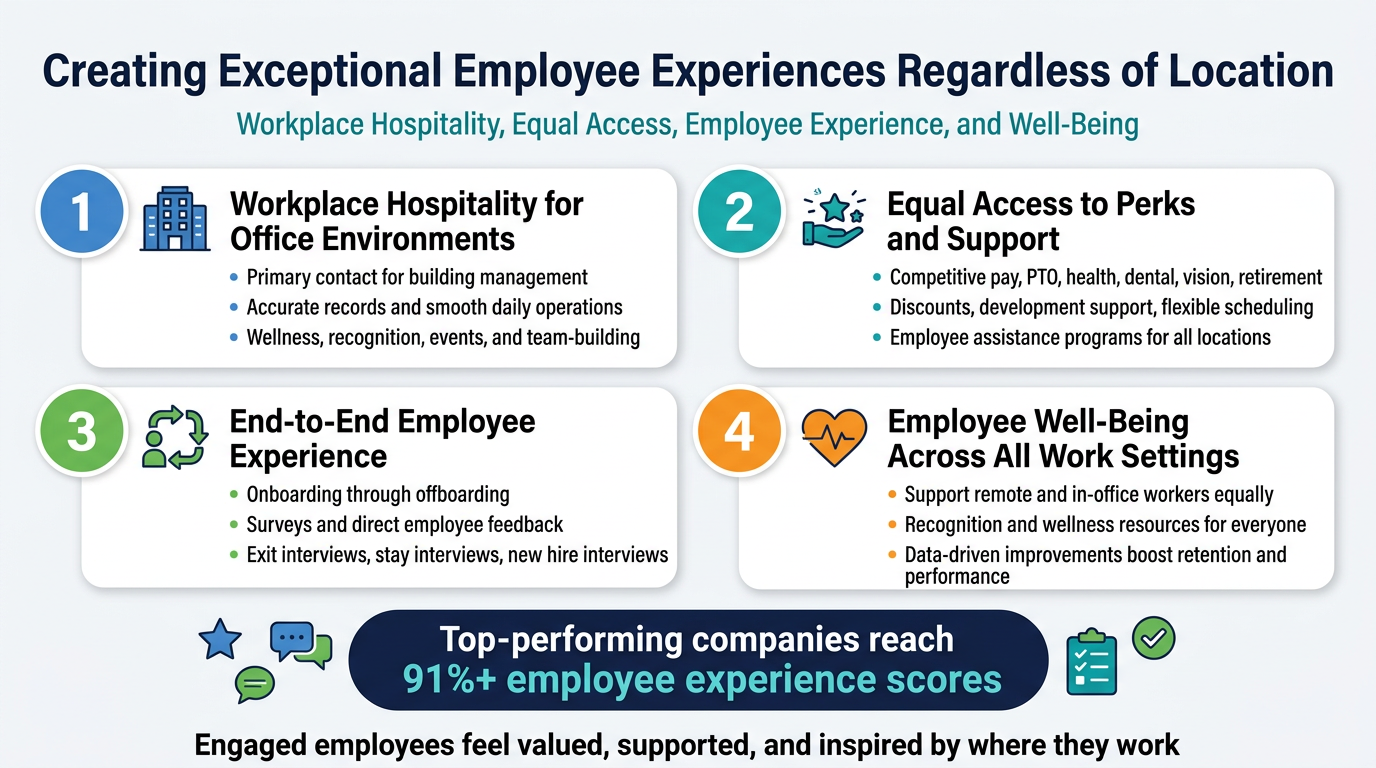
Creating an exceptional in-office experience requires a comprehensive approach to workplace hospitality that makes employees feel valued and supported. This involves establishing primary points of contact for all building management interactions and ensuring smooth operations that enhance the overall employee experience. Office environments should prioritize maintaining accurate records while supporting day-to-day operations that contribute to a positive workplace atmosphere.
Effective workplace hospitality includes implementing staff wellness initiatives, recognition programs, and employee experience initiatives that foster engagement. Organizations should focus on creating a lively and connected office culture through carefully planned events, off-sites, and regular team-building activities. This approach helps maintain high employee satisfaction scores, with top-performing companies achieving average employee experience scores of 91% or higher.
Providing Equal Access to Perks and Support Services
Ensuring equitable access to benefits and support services across all work settings is crucial for small business workplace strategy success. Organizations must develop broad infrastructure of tools and programs to enhance the employee experience, regardless of location. This includes providing competitive compensation packages, generous PTO policies, and comprehensive benefits including health, dental, vision, and retirement plans.
Employee discounts, professional development assistance, and flexible scheduling options should be accessible to both remote and in-office workers. Companies should also implement robust employee assistance programs that support workforce development strategies aligned with organizational goals. These initiatives help create consistency in the employee experience while accommodating different work preferences and arrangements.
Building End-to-End Employee Experience Strategies
Comprehensive employee experience strategies encompass the entire employee lifecycle, from onboarding through offboarding processes. This involves designing and coordinating initiatives that enhance workplace culture while managing critical touchpoints throughout an employee’s journey. Organizations should focus on gathering employee feedback through surveys and direct communication to continuously improve their offerings.
Cross-functional collaboration between HR, management, and other departments ensures consistent, engaging programs that boost employee satisfaction. The process includes conducting various types of interviews – exit interviews when employees leave, new hire interviews when they join, and stay interviews while they remain with the organization. These touchpoints help uncover important employee observations and organizational trends that inform strategic improvements.
Supporting Employee Well-Being Across All Work Settings
Employee well-being initiatives must be designed to support all workers regardless of their physical location. This requires implementing programs that address the diverse needs of both remote teams and in-office employees. Organizations should focus on fostering environments where employees feel valued, motivated, and productive, contributing to higher retention rates and better overall performance.
Successful well-being strategies involve analyzing employee feedback data to identify areas for improvement and implementing targeted solutions. Companies should develop recognition programs that celebrate achievements across all work arrangements while ensuring equal access to wellness resources and support services. The ultimate goal is creating a workplace where everyone is engaged by what they do and inspired by who they work for, leading to improved employee satisfaction and organizational success.
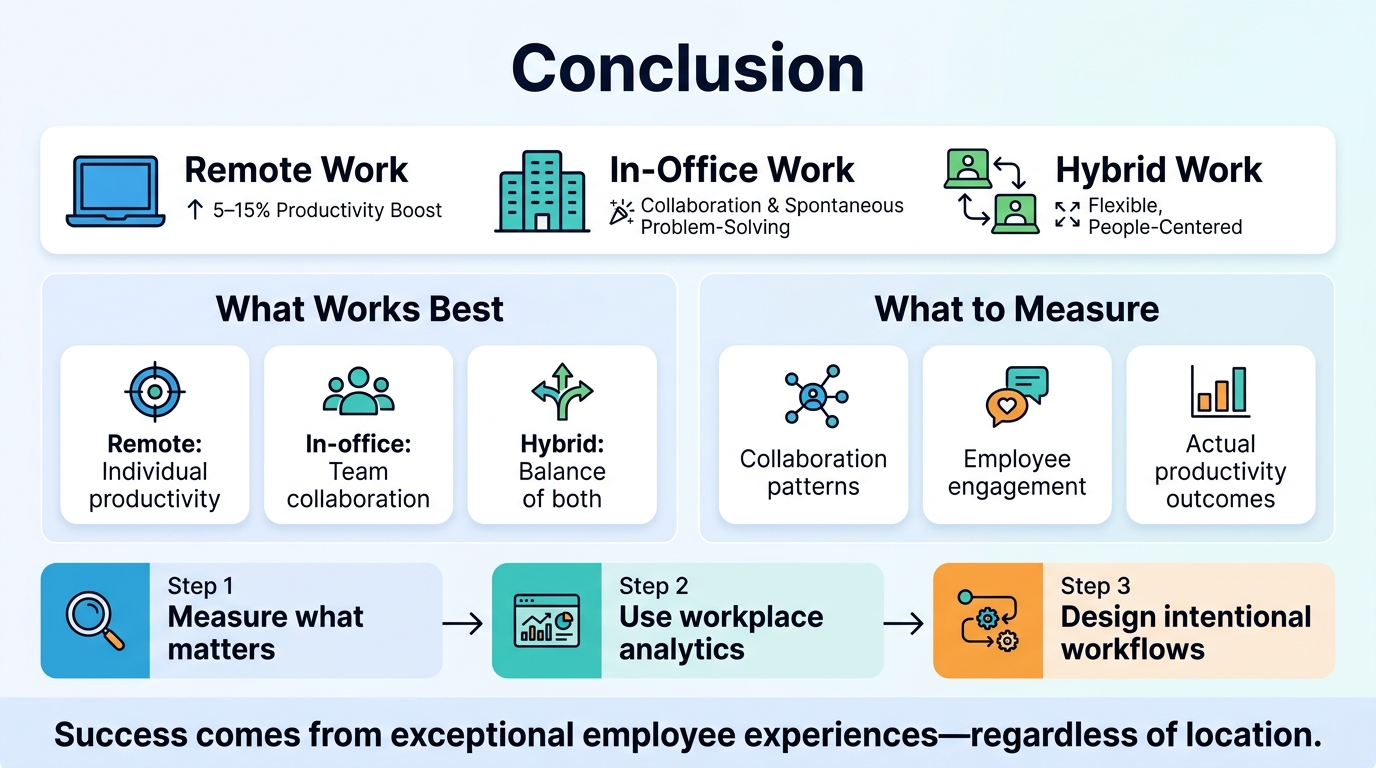
The decision between remote, in-office, and hybrid work models isn’t about finding a universal solution—it’s about understanding what works best for your specific small business needs. Data consistently shows that remote work can boost individual productivity by 5-15%, while in-office environments excel at fostering collaboration and spontaneous problem-solving. However, the most successful small businesses are those that create exceptional employee experiences regardless of location, whether through workplace hospitality services, flexible policies, or data-driven optimization of their chosen work model.
Rather than choosing sides in the remote versus office debate, focus on measuring what matters: collaboration patterns, employee engagement, and actual productivity outcomes. Use workplace analytics to understand how your team truly works, invest in the right tools and support systems, and design intentional workflows that maximize both individual focus and team collaboration. The future of small business success lies not in rigid adherence to any single work model, but in creating flexible, people-centered approaches that adapt to your team’s unique needs and goals.